


BY: ARTIST & CREATOR: SHEEFALI ASIJA COLLABORATOR: DAME CLARE GREY
At its heart, The Quantum Towers is a belief made visible that science is not only understandable but joyful, embodied, and deeply human. It invites children not just to learn, but to inhabit knowledge: to walk inside the periodic table, to see electrons as movement and story, and to feel themselves reflected in the very building blocks of matter.
Our hope is simple and radical: To create a generational shift in how young people – especially those who may never see themselves in a lab coat – encounter science. To ignite a sense of ownership over discovery, where the boundaries between physics, chemistry, biology, geology, and philosophy-knowledge, reality, art, and story dissolve.
To make space for wonder at a time when attention is short, curiosity is under pressure, and access to joyful reality is uneven.
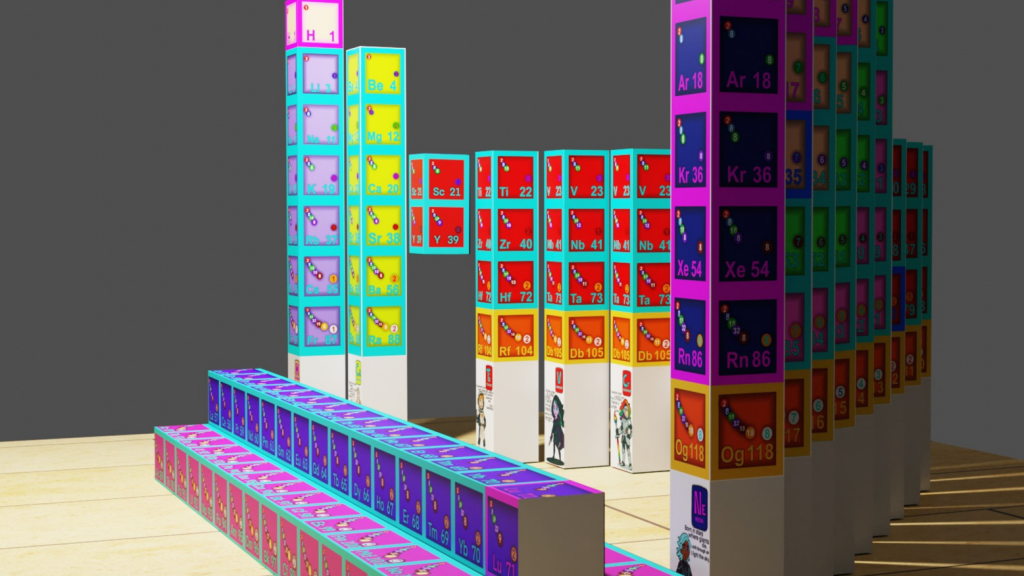
A vibrant, walk-through 3D sculpture of the Periodic Table, where the quantumcode is made visible in electron shells
A celebration of valence shells – revealing how the ability to gain or lose electrons defines each element’s character, & shapes the world they create.
A sculptural landscape of colour-coded towers and blocks, where every element’s fluid identity is brought to life
A cast of characters from the magical realm of ElementORO, each with their own verse, symbol, and role in the elemental world.
A set of illustrated ElementORO collectible cards, using simple poetic storytelling to deepen memory and meaning.
A library of interactive games, puzzles, & quests designed to make the sculpture fully hands-on – turning scientific exploration into joyful play

….COMING SOON, THE ELEMENTORO ANIMATED SERIES – LAUNCHING ON SOCIAL MEDIA AND EVOLVING INTO A TV EXPERIENCE FOR YOUNG EXPLORERS.
Children learn best when they move, play and imagine. The Quantum Towers makes science physical, visible, and personal.
It turns abstract concepts like electrons, bonding, and the periodic table into something children can touch, explore, and remember.
Characters and stories help every child feel seen in science. Games, puzzles, and scavenger hunts make it joyful and memorable.
Connects across subjects: science art, language, biology and history. Builds not just knowledge but confidence, creativity, and curiosity.
Makes the scientific method feel intuitive – observing, questioning, testing and imagining become part of play.

WHERE SCIENCE MEETS STORY, AND LEARNING BECOMES IDENTITY.
The elements reflect the diverse strengths found in every child. Some bond easily. Some stand alone. Some shine. Some explode.
ElementORO helps children say: “These elements are what I’m made of. And I matter.”
Each character’s superpower is drawn from the true science of atoms, bonds, and biology. Brought to life through CARDS, SCULPTURE, GAMES, and ANIMATION.
And where children begin to see that everything in reality – from electrons to ecosystems – is shaped by connection, collaboration, and becoming together.


Every child is a superhero – not because they wear a cape, but because they imagine, question, and explore.
across all these layers, one truth holds: connection, collaboration, and response to one another are what shape reality. from the quantum to the cosmic, we are always entangled in relation becoming through interaction.

Movements depends memory
Children learn through movement. They walk through the table, climb the towers, and move elements. Science becomes physical.
Seeing is understanding
Bold colours, patterns, and characters make concepts memorable. Each group tells a visual story. The layout becomes a learning map.

Feel it, remember it
Elements are characters with personality. Children feel connected. Learning becomes emotional and fun.
Lerning that grows
It grows with the child. KS1 explores atoms and materials. KS2 builds into bonding, biology, and deeper patterns.
All activities are designed to seamlessly support the existing curriculum — giving teachers engaging tools without adding extra workload. The sculpture pieces offer plug-in lessons that complements your planning and inspires new ways to teach, without asking for more time.
Help students understand that real-world problems are made of elements — and so are the solutions.
STEM Lessons
Use The Towers to teach chemistry, physics, biology, geology, and materials. Explore atoms, bonding, electron shells, and the science behind what everything is made of.
English & Literacy
Turn elements into inspiration for poetry, storytelling, and creative writing. Children can write from the voice of an electron or imagine a conversation between Iron and Oxygen.
Art & Design
Invite students to design their own elements or heroes. Use visual symbolism to explore traits like strength, cohesiveness, or invisibility.
Assemblies & Performances
Invite students to design their own elements or heroes. Use visual symbolism to explore traits like strength, explosiveness, or invisibility.
Sustainability & Climate Learning
Link elements to climate change, energy, water, and ecosystems. Explore how carbon bonds shape life, how metals drive technology, and how elemental choices affect our planet.

The Quantum Towers is fully aligned with the UK primary science curriculum and supports cross-subject learning.
Introduce materials, atoms, and simple properties through visual, physical exploration. Great for early curiosity and concept building.
Explore periodic patterns, valence electrons, states ofmatter, and forces. Dive deeper into electricity, bonding, and classification using storytelling and character play.
Supports teaching of:
Cross-curricular links to English, Art, PSHE, and Environmental Science: Real-world topics like climate change, energy use, and technology can be introduced through elemental connections – showing how the Periodic Table underpins our planet, choices, and future.
The Quantum Towers is fully aligned with the UK primary science curriculum and supports cross-subject learning.
Years 1-3
Introduce materials, atoms, and simple properties through visual, physical exploration. Great for early curiosity and concept building.

Years 4-6
Explore periodic patterns, valence electrons, states ofmatter, and forces. Dive deeper into electricity, bonding, and classification using storytelling and character play.
Supports teaching of:
Cross-curricular links to English, Art, PSHE, and Environmental Science: Real-world topics like climate change, energy use, and technology can be introduced through elemental connections – showing how the Periodic Table underpins our planet, choices, and future.

Key Stage: KS1
Subjects: Science, Art, Literacy
Duration: 45-60 minutes
Essential Question: What tiny things build our bodies, and where can we find them on the Quantum Towers?
Learning Objectives
Children will: Learn that stars and humans are made of elements
Identify 2-4 shared elements (e.g. hydrogen, carbon, oxygen) on The Towers and ElementORO cards.
Understand that everything in the universe is made from the same building blocks – elements, which are made of electrons (protons and neutrons can be introduced later).
Discover that elements have electron shells, and the number in the last shell decides how they bond with others.
Begin to grasp that bonding is how new things form – like water, food, and people.
Feel a sense of connection and wonder to the natural world and sky.
Express their understanding through movement, art, and story.
1. ELEMENTS OF LIFE
Subjects: Science, PSHE, Art
Essential Question: Which elements help us live and grow
Learning Objectives:
Identify key life elements (H, O, C, N, Ca, P). Match each element to a body function such as bones, breathing, and growth. Understand that food contains the same elements as our bodies.
Create an “Elements in My Lunch” drawing.
2. FROM ATOMS TO WATER
Subjects: Science, Art
Essential Question: How does water come from hydrogen and oxygen?
Learning Objectives:
Find hydrogen and oxygen on The Towers. Understand simple bonding: 2 H + 10 = water. Learn that bonding makes new things different from their parts.
Make a water droplet collage.
3. WHAT ARE STARS MADE OF?
Subjects: Science, Geography, Literacy
Essential Question: How are stars and humans connected?
Learning Objectives:
Discover that stars and humans share the same elements. Find hydrogen, carbon, and oxygen on The Towers. Understand that bonding makes new things like water and air.
Write a short “poem from a star.
4. BUILDING BLOCKS OF EARTH
Subjects: Science, Geography
Essential Question: What elements make up rocks, soil, and mountains?
Learning Objectives:
aluminium, iron, and calcium. Understand that minerals are made of bonded elements. Match rocks to the elements they contain.
Create a “rock element” rubbing or drawing.
5. MAGICAL METALS
Subjects: Science, Art
Essential Question: What makes metals strong, shiny, or bendy?
Identify common earth elements such as silicon,
Learning Objectives:
Identify three metals on The Towers. Compare their uses in everyday life. Learn that metals are elements with special properties.
Design a superhero with a “metal power.”
6. AIR WE SHARE
Subjects: Science, Geography, PSHE breathe? Essential Question: What’s in the air we all
Learning Objectives:
Identify oxygen, nitrogen, carbon dioxide Understand air is a mixture of elements and compounds Link clean air to health and environment
Make a “breathing cycle” diagram
7. GROWING WITH ELEMENTS
Subjects: Science, PSHE
Essential Question: How do plants use elements to grow?
Learning Objectives:
Identify elements plants need (C, H, O, N, P, K) Understand photosynthesis in simple terms Recognise plants as part of the same element cycle
Plant seeds and label them with their “element recipe” as us
8. MY ELEMENT HERO
Subjects: Art, Literacy, Science
Essential Question: If I were an element, what would I be?
Learning Objectives:
Learn about one element’s traits
Use imagination to turn traits into a hero design
Write a short “element story” in first person „Share and display hero designs
9. ELEMENT SCAVENGER HUNT
Subjects: Science, PE, Teamwork Skills
Essential Question: Can we find the elements hidden in The Towers
Learning Objectives:
Locate given elements using the sculpture Match element names to their symbols Work in teams to solve element clues
Build confidence in navigating the periodic table
10. ELEMENTS BORN IN STARS
Subjects: Science, Art, Storytelling
Essential Question: How do stars give birth to elements?
Learning Objectives:
Discover that supernova explosions create new elements Identify star-born elements like iron and gold on the sculpture Express learning through “starburst” art showing element creation.
Begin to understand that we are made from star matter.
11. ELEMENTS FROM THE BIG BANG
Subjects: Science, Art, History of the Universe
Essential Question: What were the first elements in the universe
Learning Objectives:
Learn that the Big Bang formed hydrogen, helium, and a little lithium Locate these elements on the sculpture Create a “birth of the universe” comic strip or painting Understand that all other elements came later from stars.
12. ELEMENTS IN EVERYDAY LIFE
Subjects: Science, Literacy, Everyday Knowledge
Essential Question: Where can we find elements around us?
Learning Objectives:
Identify common elements in food, water, toys, and clothes.
Match everyday objects to the elements they contain Locate those elements on the sculpture Build awareness that everything we see and touch is made of elements.
1. FROM BIG BANG TO YOU
Subjects: Science, History of Science, Art
Essential Question: How did the first elements form and how do they connect to us?
Learning Objectives:
Identify hydrogen, helium, and lithium on The Quantum Towers Understand these elements came from the Big Bang Learn that heavier elements were made in stars and supernovae See how those elements became part of our bodies Create an art piece showing your “element journey” from the stars to you
2. THE LANGUAGE OF THE PERIODIC TABLE
Subjects: Science, Maths
Essential Question: How is the periodic table organised and why does it matter?
Learning Objectives:
Explore colour-coded groups and periods on The Quantum Towers Understand how position predicts properties See how patterns help scientists group elements
3. VALENCE SHELLS AND BONDING
Subjects: Science, Chemistry
Essential Question: How do elements decide who tobond with
Learning Objectives:
Use The Quantum Towers’ electron shell displays to see valence electrons.
Understand that the last shell determines bonding Form simple compounds using element models Act out bonding “dances” where students link arms to form compounds
4. STATES OF MATTER AND CHANGES
Subjects: Science, Art
Essential Question: How do elements change state?
Learning Objectives:
Locate elements that are solid, liquid, or gas at room temperature Make clay or paint “state transformation” models Predict how heat or cooling changes state showing the changes
5. ELEMENTS IN YOUR BODY
Subjects: Science, PSHE, Art
Essential Question: What are we made of?
Learning Objectives:
Find oxygen, carbon, hydrogen, nitrogen, calcium, and phosphorus on The Towers Understand their roles in bones, muscles, and DNA See the shared chemistry between all humans
6. ELEMENTS IN THE EARTH
Subjects: Science, Geography, Geography, Sculpture
Essential Question: What elements shape our planet?
Learning Objectives:
Locate iron, oxygen, silicon, and magnesium on The Towers
Link them to rocks, soil, and Earth’s crust Understand cycles of minerals through nature.
Make miniature “elemental landscape” models from natural materials
7. CLIMATE, SUSTAINABILITY, AND ELEMENTS
Subjects: Science, Geography, Citizenship, Art
Essential Question: How do elements affect climate and sustainability
Larning Objectives:
Find carbon, nitrogen, lithium, and rare earth metals on The Towers
Understand their role in clean energy, climate change, and pollution solutions Design posters or collages showing “good” and “bad” elemental uses for the planet
8. METALS AND ALLOYS
Subjects: Science, Design & Technology, Play
Essential Question: What happens when metals mix?
Learning Objectives:
Locate pure metals on The Towers Understand how mixing creates alloys Play “element mix-and-match” to make imaginary super-alloys with new powers
9. ELECTRICITY AND MAGNETS
Subjects: Science, Physics, Game Design
Essential Question: Which elements make electricityand magnets work?
Learning Objectives:
Find copper, aluminium, and iron on The Towers Understand conductivity and magnetism
Make a class game where players “power up” using the right elements
10. FOOD CHEMISTRY
Subjects: Science, PSHE, Cooking Play
Essential Question: What elements are in our food?
Learning Objectives:
Find calcium, sodium, potassium, and iron on The Towers
Understand their role in nutrition
Create a “periodic plate” art project showing the elements in a meal
11. BUILDING THE UNIVERSE: COMPOUNDS AND MOLECULES
Subjects: Science, Chemistry, Play
Essential Question: How do elements makeeverything
Learning Objectives:
Select elements from The Towers to model compounds and molecules Understand basic bonding rules
Use balls and connectors to play “molecule
12. THE STORY OF GOLD
Subjects: Science, History, Art
Essential Question: Why is gold special?
Learning Objectives:
Find gold on The Towers
Learn about its origin in neutron star collisions Create gold-inspired art or jewellery using craft materials
Discover the periodic table through interactive play! These engaging games bring chemistry to life using The Quantum Towers and Elementoro cards.
Objective: Basics of chemical bonding, electronegativity and properties of elements
Gameplay:
Each child is assigned an element symbol.One child, the “electron,” must tag others to learn their element name and atomic number. Once tagged, a child must say their element’s atomic number. The “electron” must then correctly identify whether they can bond with the element or not. If they can bond they form a molecule. An element who can easily loose an electron – electropositive element next becomes an ‘electron’ and as an ‘electron’ must find a electronegative element to form a molecule with the game continues until all elements form a molecule. Many variations.
Objective: Reflect on the environmental impact of mining and using various elements
Gameplay: A storytelling circle where children listen to stories or facts about how each element is mined, used, and recycled, fostering a discussion on environmental stewardship.
Objective: Explore the role of elements in technology and sustainability
Gameplay: An interactive quest where childrensolve puzzles related to sustainable practices, such as using silicon in solar panels or lithium in batteries. The children move to the elements on the sculpture critical to green technologies, learning about their abundance and why conserving them is vital for future innovations.
Objective: Remember the position of elements while exploring the awesome variety and stories.
Gameplay:
Memorise names and properties using The Towers and elementoro cards. Many variations.
Objective: Learn how elements combine to form compounds, using The Quantum Towers and Elementoro characters.
Gameplay:
Teams receive Elementoro cards for the elements in a simple compound (e.g., H₂O, CO₂). They race to find the correct element towers, stand by them, and “bond” using a pre-decided team gesture. Once bonded, they present their compound to the group, introducing each Elementoro character and sharing a fun fact about the compound. The first team to form their compound correctly and share their fact wins.
CHARACTERS:
Host: A charismatic neutron star
Ms. Iron: A strong-willed and feisty iron atom
Mr. Gold: A flashy and extravagant gold atom
Ms. Platinum: An elegant and refined platinum atom
Mr. Uranium: An old, wise, and slightly unstable uranium atom
Audience: Various atoms and celestial bodies
Host: Welcome, everyone, to the first-ever Stellar Talent Show! Where the elements forged in the heart of stars and the depths of space come to shine. Let’s meet our contestants!
Ms. Iron: (Flexes) Hello, everyone! I’m Ms. Iron, the strongest and most magnetic personality you’ll ever meet, forged in the fiery core of a supernova.
Mr. Gold: (Twinkling brightly) And I’m Mr. Gold, the element that makes the universe a bit more splendid, brought to you by the collision of neutron stars.
Ms. Platinum: (Gracefully bowing) Pleasure to dazzle you, I’m Ms. Platinum. Like my friend Gold here, I owe my existence to the grand cosmic dances of neutron stars.
Mr. Uranium: (Shuffling slowly onto the stage) And I’m Mr. Uranium, one of the oldest and heaviest around, also a product of starry collisions. Be gentle, I’m a bit unstable.
Host: What a lineup! Today, each of you will showcase your talent, demonstrating why you’re the most spectacular element in the universe. Ms. Iron, you’re up first!
Ms. Iron: (Bends a beam of cosmic material) See this? Pure strength! But I’m not just brawn; I’m essential for life itself. (Winks)
Audience: (Cheering) Wow!
Mr. Gold: (Flashing brightly) That’s nothing. Watch me reflect light like no other, making everything around me glow with value. (Everything on stage sparkles)
Ms. Platinum: (Elegantly forms a catalytic converter) I’m not just about looks; I help clean your planet’s air. Behold, the power of catalysis!
Mr. Uranium: (Glowing slightly) Well, I might be old, but I can heat things up! (A small lightbulb lights up near him) I’m the heart of nuclear power.
Host: Incredible! Each of you has shown why you’re special. But how do we know about your origins and talents?
Ms. Iron: Astronomers observe supernovae, where stars like me are born, using telescopes.
Mr. Gold: And scientists use spectroscopy to see the unique light we emit, tracing us back to neutron star collisions.
Ms. Platinum: Plus, the discovery of gravitational waves has unveiled secrets of our cosmic dance.
Mr. Uranium: Indeed, each method helps peel back the layers of the universe, revealing our stories.
Host: Thank you, contestants, for a stellar show! And remember, kids, every element has its story, its sparkle, and its strength, all thanks to the wonders of the cosmos.
Audience: (Applause)
Host: That concludes our Stellar Talent Show! Keep looking up, and who knows what other elements you’ll discover in the stars above
CHARACTERS:
Host: Now the wise guide of the quest
Ms. Iron: The strong and magnetic leader
Mr. Gold: The charming diplomat
Ms. Platinum: The elegant strategist Mr. Uranium: The knowledgeable elder
Ms. Helium: A light-hearted, noble gas they meet on the way
Mr. Carbon: A versatile, life-giving element, potential friend or foe
Setting: A fantastical universe, with planets and stars forming the backdrop for an epic quest to discover new elements.
Scene 1: The Gathering
Host: Gather round, brave elements! We embark on a quest to explore the cosmos, seeking new elements to join our grand periodic table. Are you ready?
Ms. Iron: Ready and raring to go! With my strength, we’ll face any challenge.
Mr. Gold: I’ll make sure we’re well-received wherever we go. After all, all, who doesn’t love gold?
Ms. Platinum: Strategy will be key. I’m here to ensure our journey is smooth and successful.
Mr. Uranium: And I’ll provide the wisdom of ages. Let’s uncover the secrets of the universe together.
Scene 2: Encounter with Ms. Helium
Ms. Helium: (Floating down gracefully) Hello, travelers! I’m Ms. Helium, a noble gas, light and unreactive. Can I join your quest?
Ms. Iron: (Skeptically) What strengths do you bring to our quest?
Ms. Helium: I’m great at lifting spirits and even better at staying out of trouble, thanks to my nobility.
Mr. Gold: (Laughs) Welcome aboard, Ms. Helium! Your light-heartedness will surely brighten our journey.
Scene 3: Meeting Mr. Carbon
Mr. Carbon: (Appearing in various forms) Greetings, adventurers. I’m Mr. Carbon, the basis of all known life. I can be your greatest ally or your trickiest challenge.
Ms. Platinum: (Cautiously) Your versatility is impressive, Mr. Carbon, but can we trust you on our quest?
Mr. Uranium: Wisdom tells us that every element has its place. Mr. Carbon, show us your friendly side, and let’s make history together.
Mr. Carbon: Very well, I’ll join your quest. Together, we’ll explore the stars and maybe even create new forms of life.
Scene 4: The Conclusion
Host: Our quest has brought us new friends and taught us the power of unity and diversity. Each element, unique in its own right, contributes to the beauty of the cosmos.
Ms. Iron: I’ve learned that strength isn’t just about force, but about the bonds we form.
Mr. Gold: And I’ve seen that true value comes from how we shine together, not just alone.
Ms. Platinum: Strategy and wisdom have guided us, but it’s our new friendships that have truly enriched our journey.
Mr. Uranium: As we return from our quest, let’s remember the adventures we shared and the lessons we learned about the elements and ourselves.
Modular and mobile
Easy to install indoors or outdoors – in halls, playgrounds, or open classrooms.
Built for daily use and deep integration
Supports everyday learning, cross-curricular projects, and creative teaching year-round.
Customisable for your school
Adaptable to your setting, age range, and curriculum focus – built to fit and to last.
Multiple formats available
Full sculpture experience with The Towers and ElementORO character cards
Along with scaled-down classroom edition for smaller spaces.
Digital and animation add-ons for blended or home learning.
THE QUANTUM TOWERS IS DESIGNED TO BE FLEXIBLE, INCLUSIVE, AND IMMERSIVE. IMMERSIVE.
All Plans are:
Sculpture custom made and delivered to school
Materials sustainably & locally sourced
Resource pack
ElementORO Cards, elemental scavenger hunts, group bonding games, walkable explorations &puzzles. (ElementORO animated series to come)
Cross-Subject Lesson Plan Bank
A collection of ready-to-use lesson plans that connect science with other core subjects.
Designed to help teachers save time, deliver creatively, and teach with confidence.
Includes activities that combine:
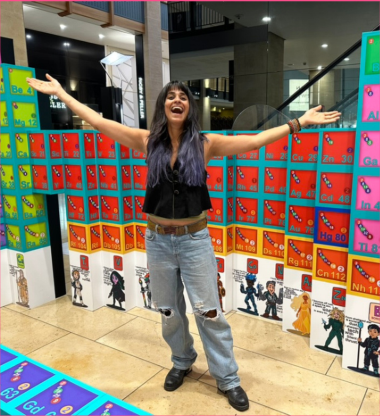
Sheefali Asija is an interdisciplinary artist whose work bridges science, myth, and humanity. With a background in visual storytelling and a deep interest in elemental systems, her practice explores the invisible architectures that shape our world-from atomic structures to ancestral memory. Through sculpture, installation, and narrative design, Sheefali transforms scientific concepts into emotionally resonant experiences that engage both children and adults. Her latest work, including The Quantum Towers and the world of Elementoro, invites audiences into spaces where wonder, knowledge, and imagination converge.
She is the Humanism Ambassador for ideaXme, a global platform dedicated to celebrating the power of ideas to move humanity forward.

Art is to me as an artist is like science to a scientist. It is a way of making observations about the world. It is a process of slicing the world apart and then reconstructing it – making connections new and some old but always telling a new story. Always hoping for a new insight – always a new way of looking at the same thing” – Sheefali”

Dame Clare Grey is a pioneering chemist internationally renowned for her groundbreaking work in energy storage and battery technology. As a Professor of Chemistry at the University of Cambridge and a Fellow of the Royal Society, her research has transformed our understanding of lithium-ion and next-generation batteries. Using advanced nuclear magnetic resonance (NMR) techniques, she explores the atomistic-level behaviours of materials that power the modern world-from mobile devices, electric vehicles to storage on the electrical grid.
She believes that science must serve society, and that sustainable innovation is only possible through deep, collaborative inquiry. Clare’s work not only advances clean energy solutions but also inspires a new generation of scientists committed to curiosity, integrity, and global impact
“We aim to understand how materials function so as to shape the future of energy. If we can see atoms in their local environments and work out how they move, we can redesign the world” – clare